 English
 German
 French
 Russian
 Spanish
 Japanese
 Korean
 Portuguese
 Ukrainian
 Arabic
 Italian
BPA-Free Materials for Reusable Plastic Cups: How Dingnuo Ensures Safety in Production
Plastic cups are a daily staple for many, but the concern over Bisphenol A (BPA) has pushed manufacturers to adopt safer alternatives. BPA is an industrial chemical used in polycarbonate plastics and epoxy resins, and its potential health risks have led to a growing demand for BPA-free products. What exactly does "BPA-free" mean, and how can a factory guarantee it? In this article, we look at the common materials used for reusable plastic cups and the verification steps in production, backed by the expertise of Yongkang Dingnuo Industry and Trade Co., Ltd.
Common BPA-Free Materials for Reusable Plastic Cups
Several food-grade plastics are naturally free from BPA, each offering unique advantages for drinkware:
- Tritan (Copolyester): Developed by Eastman, Tritan is a high-clarity plastic that is BPA-free. It offers excellent toughness, good chemical resistance, and can handle both hot and cold beverages. It is widely used in sports bottles and tumblers.
- Polypropylene (PP, Resin Code 5): PP is a lightweight, durable plastic that is heat-resistant and safe for food contact. Many reusable cups are made from PP because it is dishwasher safe and has a neutral taste.
- High-Density Polyethylene (HDPE, Resin Code 2): HDPE is known for its strength and rigidity. It is often used for bottles and containers and does not contain the harmful bisphenols found in older plastic grades.
- PES / PPSU: Polyethersulfone and Polyphenylsulfone are premium options offering higher temperature resistance and clarity. They are popular for baby bottles and high-end drinkware.
How BPA-Free Status Is Verified in Production
Creating a BPA-free cup is not just about choosing the right raw material. Responsible manufacturers implement a multi-layered verification process to ensure every batch meets strict safety standards.
1. Raw Material Certification
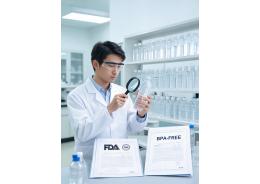
Every batch of resin should come with a certificate from the supplier confirming that it complies with FDA regulations (21 CFR) or the EU food-contact framework (EU 10/2011). This document serves as the first line of assurance for BPA-free and food-safe materials.
2. Incoming Quality Control
At the factory, incoming materials are quarantined until samples pass identification tests such as infrared spectroscopy (FTIR) to confirm polymer identity. Migration tests may also be performed to ensure no undesired substances transfer into the food or beverage.
3. Production Process Control
During injection molding or blow molding, production lines are thoroughly cleaned and dedicated equipment is used for BPA-free materials to prevent cross-contamination. Process temperatures and parameters are continuously monitored to avoid polymer degradation.
4. Finished Product Testing
Random samples from each production lot are sent to accredited third-party laboratories, such as SGS, for BPA migration testing. Methods like solvent extraction and liquid chromatography-mass spectrometry (LC-MS) detect BPA at levels as low as 0.01 mg/kg. Only batches that pass are allowed to ship.
5. Certificates of Compliance
Finished cups are accompanied by BPA-free certificates and food-contact material documents. These can be provided to retailers, importers, and consumers for full transparency.
Dingnuo's Quality Promise
Yongkang Dingnuo Industry and Trade Co., Ltd. has more than 10 years of experience in manufacturing plastic cups, water bottles, and vacuum drinkware. Our 12,000-square-meter factory produces 20,000 units daily for demanding markets including the USA, South Korea, and Japan. We take extra care to ensure that all products exceed industry standards, including strict BPA-free requirements. From material selection to final inspection, every step is designed to give you confidence in your reusable cup.
If you are looking for a reliable custom drinkware manufacturer, contact us at [email protected] or call +86 18314807327.